Sunday, April 20, 2008

Gospel for April 27, 2008 - John 14:15-21, The Sending of the Holy Spirit

John’s audience were non-witnesses of Jesus’ life on earth. They were people in a community who have heard about Jesus’ life and ministry from secondary sources. We, the singles apostolate, are in the same situation as John’s audiences. We did not experience being with Jesus physically but He is spiritually present in our lives.

In this gospel, Jesus sent an Advocate to be with us as He goes back to the Father. In other versions of the gospel the term “Paraclete” was used. “In Greek the word “parakletos” comes from “para” = alongside of, and kaleo = to call, which refers to any “resource person” who is called at the side of an accused in order to help the accused in his defense. The word “Paraclete” has a lot of nuances such as counsellor, attorney, lawyer, helper, assistant, defender, auxiliary, spokesman, witness.”[1] The Holy Spirit who Jesus has sent can have many roles in our lives, depending on the situation when we need to call on the presence of Jesus. John also emphasised that there is no distinction between Jesus and the Holy Spirit. Jesus may no longer be present with us physically but He is still with us spiritually and very much present today even 2000 years later through the Holy Spirit.

The second learning is Jesus’ reminder that “keeping the commandment is also keeping His word” and that it cannot be taken separately. Keeping Jesus words or teachings means believing in them. However, it is not sufficient that we just believe in His teachings, there should be an action or an obedience manifested in our behaviour. If we say to ourselves, yes I believe and accept Jesus as my Lord and saviour, then I should show this through concrete actions of love for one another. In the same way, good works without faith is also insufficient for a Christian.

Discussion Question:

In using the word “paraclete,” John suggests that the Holy Spirit (or Jesus’ spiritual presence today) can work in many ways. How does the Holy Spirit work in your life?


[1] Hungry No More, p. 191, v.16

Tuesday, March 18, 2008

Gospel for

There are two gospels in the Church calendar for Easter Sunday. The to be read in the morning is John 20:1-9, and the one in the evening is Luke 24:13-35. The two Gospels celebrate the resurrection of Jesus Christ. We are told of two aspects about the Resurrection in both gospels.

The first is that the Resurrection of Jesus is a bodily Resurrection. In John 20:1-9, the author gives a very detailed account on how Jesus’ followers found the tomb empty where Jesus was buried.

In Luke 24:13-35, it explains that Jesus Resurrection is also a spiritual Resurrection. When two of His followers were talking with Jesus Himself on their way to Emmaus, they did not recognize Him; meaning that his Resurrected body is no longer the same as before His death. They only recognized Him when He was already breaking bread with them. How exactly is it different? No one knows.

Jesus died and seized to be with us physically but when He resurrected from the dead, He became alive but not in the same physical form. It is unlike the resuscitation of Lazarus who was brought back to life in his own body and later on died again. Jesus’ resurrection transformed Him in a way that even His disciples could not recognize Him. Resurrection is not just resuscitation of the body, but also a spiritual transformation.

The Resurrection reminds us that Jesus is alive and is with us even to this day. It is the cornerstone of our faith. But every time we proclaim the Resurrection to others, imagine that other person asking you, “How can you prove that?” The best proof we can give that person is by showing him or her that Jesus is alive. How? By living the way Jesus lived. Jesus is alive when we are just, humble, selfless or when we share with the poor just as Jesus did when He was physically with us. When we love and forgive others, then we show that Jesus is alive.

How is Jesus alive in your life? How can you show the people you work with that Jesus is alive?

Sunday, March 09, 2008

Gospel for March 16, 2008 - Matthew 26:14 - 27:66 - Passion and Death of Jesus

Matthew narrates in the gospel the events that took place in Christ’s passion and death. One of the important events that happened was Jesus’ agony as he prayed in the garden of Gethsemane. Jesus took Peter and the two sons of Zebedee, James and John, the three disciples who were allowed to see his glory at the Transfiguration, in order to witness and share his suffering.

Peter, James and John were part of the glorious event of Jesus’ Transfiguration – they were fully transfixed on Jesus as he was transfigured and his full divine glory manifested. This is in stark contrast to their behavior in the garden of Gethsemane where they had trouble keeping awake to watch and pray with Jesus during the lowest point of his life. He pleaded for companionship and comfort from them as the hour of his passion approached. It was at this time that Jesus, full of sorrow and anguish, fell on the ground and prayed three times saying, “My Father, if it is possible, let this cup pass from me; yet, not as I will, but as you will (v.39).”

It was through the persistence in prayer that Jesus gained a clear knowledge of the Father’s will. He prayed for an escape from the situation, but he also knew that this was not possible. He then counts on God to complete His plan of salvation and in deep surrender accepts the cup of suffering he has to undergo for the sins of the world. Matthew shows Jesus as a model of prayer and obedience by submitting his will in obedience to the divine will. Thus, Jesus reversed the sin of man’s disobedience by obeying the Father in all things.

The passage helps us to reflect on our own prayer life as singles. We may experience difficulty when we pray since we are faced with a lot of distractions (e.g. when we are tired and sleepy, when we are occupied with work, when we have no time, etc.). When things are going well in our lives, sometimes we tend to forget to pray. It is when we encounter problems that we remember God. But when the problems become too great for us, such as death of a loved one, loss of a job, grave sickness, and the like, our tendency is to leave God by blaming Him and asking Him “Why me?” Jesus teaches us the importance of perseverance in prayer so that we do not become weak, fall into temptations, and abandon Him, but rather strengthen our spirits by always recognizing and obeying God’s will especially in times of difficulty.

§ In what ways can we strengthen our prayer life so that we continue to easily recognize and do God’s will especially during the low points in our lives?

§ How can we be a model of prayer and obedience for others?

Sunday, March 02, 2008

Gospel for March 9, 2008 - John 11, 1-45 Jesus Raises Lazarus

(By Mike Gan, reviewed by TM)

The raising of Lazarus is the final sign in Jesus’ public ministry which leads to his condemnation and death. It is also the most powerful and important sign because it does not merely involve healing the sick and feeding the hungry, but raising someone from the dead, a power proper only to God.

In the Gospel, when the most powerful sign is about to be performed, Jesus behaves in a shocking manner. John prepares us by first saying that Jesus loved Lazarus and his sisters. Jesus loved them and yet, when he heard that Lazarus was sick, he stayed where he was for two more days. Why would Jesus do that?

John wanted to highlight that Jesus always acts in accordance with his Father's will, not the will of his family or his closest friends. He is concerned first and foremost with God's glory, with doing God's. His love does not feel like love at first, but it is. But as we shall later on see, it is for the best. His seeming delay will lead to a greater blessing.

Today we easily find ourselves in difficult and even painful situations. We cry out for help but there are times when God seemingly delays in answering our prayers.

What is my attitude when I feel that God delays in answering my prayers? How do I find faith and comfort in those trying times?

Monday, February 25, 2008

Sunday Gospel for March 2, 2008 - John 9:1-41 The Man Born Blind (By Estie and TM)

John is usually more difficult to interpret than the other gospels because he uses several symbolisms. It would be helpful to understand the following:

· This passage takes place during the Feast of the Tabernacles or the Feast of Booths (or Tents). During this feast, the Jews recall the time when they wandered in the dessert for 40 years and lived in tents. It is also known as the feast of lights because the temple was brightly illuminated at night. It is during this feast that Jesus declares “I am the light of the world.” (8:12).

· The waters of Siloam, was used in the water ceremony of the feast. The High Priest would draw water from Siloam and bring it back to the temple to be poured out. Jesus uses this water for the blind man to see the light.

The blind man is physically healed after the clay is washed away but his spiritual eyes take time to be opened. His level of conviction increases as he is opposed by neighbors, his own parents and the Pharisees. He starts by referring to Jesus as “the man called Jesus;” later “He is a prophet;” and eventually, he says “Lord, I do believe.”

On the contrary, the Pharisees, who were supposed to be the most knowledgeable about the law and about God chose NOT to believe. They regarded Jesus as a sinner because He healed on a Sabbath; rather than believe He was from God because the blind man can now see. Their pride and self-righteousness prevented them from seeing the truth.

The pride of thinking that we know everything can prevent us from seeing what is right and true. When others see things differently, our self assurance sometimes prevent us from stepping into the light because change can be painful. For example, there are many times when we say, “this is just the way things are done around here,” or “new ideas are good, but also risky,” or even “there are two ways to do things in the apostolate: our way and the wrong way.” The gospel teaches us that God speaks through every person, even those we may regard as totally blind and wrong.

Discussion:

What beliefs do you have about any area in your life (social relationships, community, career, spiritual) that other people see very differently? In what way might God be speaking to you through that person?

Source: Nil Guillemette, SJ. Hungry No More, pp. 116-127.

Sunday, February 17, 2008

Sunday's Gospel for Feb. 24, 2008 - John 4:1-42 Jesus and the Samaritan Woman

In this Sunday’s gospel, Jesus initiated a conversation with a Samaritan woman who was drawing water from the well.

Historically, Jewish men did not speak to women in public, much less to women of Samaria since racial hatred and tension between Jews and Samaritans were common in those days (Jews were the “Chosen People” and Samaritans were considered as a “contaminated” or mixed race having intermarried with foreign invaders). It can also be observed from the gospel that she was not only an ordinary Samaritan but one with a disreputable lifestyle, having had five husbands in the past and not even being married to the man she was living with.

Despite the woman’s personal history, Jesus not only initiated a conversation with her but it seemed as though He even sought this woman out. Jews normally avoided contact with their Samaritan neighbors by traveling other, longer routes but it says in John 4:4 that Jesus “had to go through Samaria”. Jesus deliberately went to Samaria, breaking down barriers and boundaries, to meet this woman, to seek her out and offer her “living water”.

The gospel offers a challenge for us today to be like Jesus to the Samaritan woman – to reach out to people who are difficult to reach out to.

In our workplaces and in the apostolate, there are people who we have avoided because of their irregular lifestyles or just because they are “different,” “difficult,” “or do not conform to our values.”

Who are these people and how are you going to be like Jesus to them?

The Singles Apostolate’s GK Outreach Program allows us to reach out to those in need. When are you going to set aside time to visit and help them?

Tuesday, February 05, 2008

Sunday Gospel for February 10, 2008: Matthew 4:1-11 Temptation of Jesus

Matthew’s account of Jesus being tempted in the desert and overcoming these trials bring us back to the Old Testament where the people of Israel underwent the same tests in the desert and failed. Jesus quotes scripture (Deuteronomy 8:3 ; 6:16; 6:13) likening His temptation in the desert to that of Israel’s, but in this case not relying on His messianic power to deliver Him from temptation as He could have, but as man, remaining dependent on His father and fully faithful to His commands to deliver Him from evil.

It is also noteworthy that the Spirit that descended upon Jesus at his baptism in the Jordan River narrated in the previous chapter is the same Spirit here that deliberately led Him into the desert to be tempted by the devil. The Spirit did not spare God’s own son, from having to undergo testing himself.

We often feel “spirit-filled” after a prayer meeting, an SE weekend, or when a prayer intention has been answered in the way we have hoped for. We fail to realize that the same Spirit that is upon us during all those uplifting experiences is the same Spirit that brings us face to face with trials/temptations that put your faith into action – financial problems, death of a loved one, the trap of habitual sins. But Jesus in his humanity gives us hope and shows us how these trials can be overcome - with obedience and abandonment to the will and protection of the Father.

Reflection Question:

1. What has been my attitude towards the trials and temptations in my life as a renewed Catholic

2. What current situation/temptation am I experiencing that the Lord is asking me to abandon fully in order for His will to be done?

Sunday, January 27, 2008

Sunday Gospel for Feb. 3, 2008: Matthew 5:1-12 The Beatitudes

The Sermon on the Mount is one of the highlights of Jesus’ ministry, the first part of which is referred to as the Beatitudes. The word “beatitude” is from the Latin word “beatus,” meaning “a state of utmost bliss,” of “supreme happiness,” of “true happiness.” The Beatitudes are often misinterpreted as “it is good to be poor.” Further study of the gospel shows otherwise.

The Beatitudes were declarations of blessings for the marginalized sector of society during Jesus’ time. Even during the Old Testament times, those who were considered poor enjoyed the special protection of kings and were favored by God. This “divine” favor was not attributed to their social status or inner disposition but because of God’s disposition towards them. Hence, Jesus’ ministry affirmed what the prophets said about the Messiah. This is the reason why Jesus came: to seek out and save the last, the lost and the least. “The Sovereign Lord has filled me with His Spirit. He has chosen me and sent me to bring good news to the poor, to heal the broken-hearted, to announce release to captives and freedom to those in prison.” (Isaiah 61:2)

Jesus incessantly preached about the Kingdom of God – that it is not a place but a condition where justice, equality, well-being, love and forgiveness prevails. Thus, Matthew’s message to his audience (mostly Jewish) during his time was for them to favor the poor and marginalized just as God found favor with them, because God made them co-heirs of His Kingdom as well.

The same message resonates in the Catholic Church today. The 2nd Plenary Council of the Philippines declared, "Following the way of our Lord, we opt to be a Church of the poor.” As Jesus’ followers, Filipino Catholics are enjoined to have a preferential love for the poor because of the abject poverty and misery that a great number of Filipinos find themselves in. The poor should be welcomed, made to feel at home and actively involved in our Church, if we are to follow the way of Christ. The late Pope John Paul II describes this option very succinctly and exhorts us to rise to the challenge: “This love of preference for the poor cannot but embrace the immense multitudes of the hungry, the needy, the homeless, those without medical care and, above all, those without hope of a better future. To ignore these realities would mean becoming like the ‘rich man’ who pretended not to know the beggar Lazarus lying at his gate.”

As a Catholic, what little things can you do to rise to the challenge to live out the preferential option for the poor? As a member of the Singles Apostolate, how can you improve your involvement in the Outreach ministry?

Sources: Guillemete, Nil, A Kingdom for All, p. 151

Catechism for Filipino Catholics

Sunday, January 20, 2008

Gospel for January 27, 2008 - Matthew 4:12-23, The Beginning of Jesus Ministry

The Gospel presents the beginning of the ministry of Jesus. It started in the region of Zebulun and Naphtali, and it is also in this location where Jesus called his first disciples.

As a background, all the four gospels mention that Jesus’ ministry started in Galilee, but it is ONLY Matthew that also mentions that Galilee is located within Zebulun and Naphtali. There must be a significance to this. Zebulun and Naphtali were two of the 12 sons of Jacob, and when the Jews entered Canaan, the land was parcelled among the sons, and Zebulun and Naphtali got the land where Galilee is located. The region of Zebulun and Naphtali were eventually overran by Assyrians and Greeks, and were therefore considered as “pagan” (or not purely Jewish) land because of the intermarriages between these foreigners and the Jews.

The Jews were known as the chosen people of God but it is ironic to know that they were also the ones to reject Jesus and His teachings. Matthew emphasizes that Jesus started His ministry in a land considered as “contaminated” or pagan. Matthew’s message is that Jesus gives priority to those who do not know God over those who are already close to God, as in the case of the Jews.

Today, we are reminded by this gospel to reach out to those who do not know God, those who are far away from Him and those who choose to be stubborn to let Him in their hearts. We are all called to evangelise like Christ. Like Jesus, we should start seeking for people outside of our apostolate, or those who are not yet familiar with Jesus.

Relate an experience when you had the chance to evangelise about God to those outside the apostolate who do not know Him or do not yet have a personal relationship with him. Was this a favourable or non-favourable experience? As you share this with the class, let this experience serve as a “push” for you to begin the ministry of evangelising to others.

Wednesday, January 24, 2007

Luke 4: 21-30 The Townmates Mentality

Observation:

The gospel passage happens right after Jesus’ entry in a synagogue in Nazareth, where he reads a passage from Isaiah. The question in our minds is why is there a sudden change in the mood and attitude of the Nazarenes towards Jesus. Verse 22 says, “they spoke highly of him.” But by verses 28-29, his town mates were “all filled with fury” and were about to hurl him down a hill. What happened in between?

Interpretation:

The keys to the answer to this question are in the following verses:

- Verse 22: “Isn’t this the son of Joseph?” – In asking this question, the people meant that since Jesus is a fellow Nazarene (remember that this scene happens in Nazareth), then Jesus should favor those who are his townmates and perform the same miracles for them as he did in other towns.

- Verse 25 – 27: In these verses, Jesus cites the examples of two great prophets of Israel – Elijah and Elisha – who did not favor his fellow Israelites, regarded as God’s chosen people, but instead took the side of a widow in Sidon and Naaman the Syrian. Both Sidon and Syria are Gentile (or pagan) territories!

Jesus statements meant: not only they not deserve his miracles, but that their own great prophets preferred Gentiles over them. Hence, they were infuriated.

Luke disagreed with the Jewish mentality that God’s favor rests with the Jews simply because they were Jews. The Kingdom of God is no longer limited to the Jews but to those who practiced the gospel values of love and forgiveness, whether Jew or Gentile. Universality is a key message of Luke’s gospel. God does not favor anyone on the basis of race, position, or religion, but “men and women of good will.” (However, if there is a group that Jesus favored, according to the gospel of Luke, it is the poor.)

Generalization:

Mere membership in the Catholic Church (or Singles Apostolate, or in the Renewal movement) is not a badge which earns special favor from God. We cannot have the mentality that because we are “active” members in the Apostolate, then we deserve that most, if not all, of our prayers be answered. That would be the “townmates mentality” that Jesus referred to in the Gospel. He did not agree with it because it is like putting God in a bottle. Rather, membership in the Apostolate recognizes that this is ALREADY a favor given to us by God, and that membership poses a demand to share this personal experience of God by serving others.

Application:

- Share some examples when you catch yourself with the “townmates mentality.” For example, a promotion you were hoping to get did not materialize. Someone with a “townmates mentality” would say, “after all the service I’ve done, I can’t accept that God would not grant me this favor.” Rather, the proper stance to take would be: “I accept this event as God’s way of continually forming me; I know he has something better in store for me.”

- The theme of the forthcoming Singles Apostolate Leaders Conference is “Offering our Best Fruits.” How can we use our membership in the Apostolate to offer our best fruits to God?

Tuesday, October 10, 2006

The Rich Man, Mark 10:17-30 by Maryann Gan (SE-7)

OBSERVATION:

A rich man went up to Jesus, called him good teacher and asked the way that leads to eternal life. Because the rich man has observed the commandments all his life, Jesus said that there is only one thing lacking and that this is to sell everything that he owns, give to the poor and follow him. The rich man felt sad and left because he had many possessions.

INTERPRETATION:

In the Old Testament, wealth and material goods are considered a sign of God’s favor. The words of Jesus astonished the disciples because of their apparent contradiction of the Old Testament concept. Jesus teaches his disciples that wealth, power, and merit generate false security. Jesus rejects them utterly as a claim to enter the kingdom. In the Old Testament, everything had already been said about what a person should do to gain eternal life, by observing the commandments of justice and compassion. Now Jesus proposes to the rich man a new way and a new experience of liberty, through becoming his follower and imitator.

Jesus does not only speak of reward in the next life. He is telling his disciples that in this world, in the midst of persecution, those who sacrifice themselves for the Kingdom will find friendship, joy, and human fulfillment far greater than anything they could have hoped for.

GENERALIZATION:

The message of the gospel is NOT to give up wealth, but to give up attachments. A person can be rich in a lot of things and thus be attached to these things. He can be attached to money, reputation, health, intelligence, friendships, etc. To be attached means to love something or someone possessively, to love in which love of self plays a predominant role. Any kind of selfishness contradicts the spirit of Jesus, and is incompatible with the Kingdom of God. Jesus shows us how to experience the Kingdom of God in this world by freeing us from these attachments that distracts us from focusing on God.

APPLICATION:

What are your attachments in life? How are they hindering your spiritual growth? How are these affecting your relationship with God, with other people? Make a resolution to give up one attachment.

Tuesday, August 22, 2006

John 6:60-69 This Saying is Hard

By Maryann Gan (edited by TM):

Observation

The Gospel begins with the murmuring among Jesus’ disciples: “This saying is hard, who can accept it?” Whatever they were murmuring about was enough to provoke some disciples to leaving him. It must be noted that Jesus did not stop those who wanted to leave.

Interpretation

When the disciples say, “this saying is hard,” it does not mean that it is “difficult to understand,” but “difficult to accept.”[1] What was it that was difficult to accept which provoked some disciples to leave Jesus? It is Jesus’ claim of being “the living bread that came down from heaven” (John 6:41).

Jesus’ listeners could not accept the mystery that this “bread from heaven” will be humiliated on the cross. They did not want to be associated with shame and scandal. John therefore addresses the second teaching that is “difficult to accept” during the early Christian times. The first was the theme of last Sunday’s gospel: that Jesus is present in the eucharistic bread and wine. The second is that Jesus came down from heaven, which is to be interpreted as coming from the Father.

A true disciple believes and knows the glory of the risen Christ through eyes of faith. This is the significance of Peter’s words when he says “Lord, to whom shall we go? You have the words of eternal life. We now believe and know that you are the Holy One of God.” For John, the words “believe” and “know” are synonymous. To believe is to know, and to really know Jesus is to believe in him.

Generalization

Faith entails accepting even things that are “difficult to accept,” not just those that are convenient to accept. To be a Christian means to believe in Jesus: who he is, and what his entire life stands for: a life of love, forgiveness and complete obedience to the Father. For many, if not all of us, it may be seem “easy” to accept that Jesus is indeed the Son of the Father, and that he is truly present in the Eucharistic bread and wine we receive in the Mass. But being a Christian is more than belief in a doctrine, it is living a life like the life Jesus lived.


Application

There are those whose reasons for joining a church community are temporal. For examples, spiritual excitement during prayer meetings, fellowship which brings temporary relief from a personal problem, or even membership in a community which brings certain honor or social advantages. When prayer did not bring spiritual relief, when the spiritual "high" was gone, when fellowship did not satisfy one's social agenda, when social pressure against fellowship became so great, leaving became a viable and desired option.

But when one joins a community so that he/she can help and be helped by others to live like Jesus lived, then such members remain and are sustained by the community.


1. What are your reasons for joining the Singles Apostolate or a Renewal Community? What are the values of the Apostolate that is difficult for you to accept and make a part of your life?

[1] Nil Guillemette, SJ, Hungry No More, Manila: St. Paul’s Publications, 1989, 104.

Tuesday, August 15, 2006

John 6:51-58 Eat my flesh, drink my blood (Gospel for Aug. 20, 2006)

OBSERVATION:

If we were among the audience of Jesus in the gospel, we would wonder whether Jesus, in telling his disciples to “eat his flesh, and drink his blood,” is speaking symbolically or literally. Just observe the many times he repeats the references to his flesh to be eaten and blood to be drank:

- Verse 51 – The bread that I will give is my flesh for the life of the world.
- Verse 53 – Unless you eat the flesh of the Son of Man and drink his blood, you do not have life within you.
- Verse 54 – Whoever eats my flesh and drinks my blood has eternal life
- Verse 55 – For my flesh is true food, and my blood is true drink.
- Verse 56 – Whoever eats my flesh and drinks my blood remains in me
- Verse 57 – … the one who feeds on me will have life…

Having repeated himself so many times, Jesus insists that indeed what he is saying is to be taken literally.

INTERPRETATION:

Unlike the other three gospels, the gospel of John does not have a Eucharistic meal during the last supper. Instead, John presents the washing of the feet. The gospel for this Sunday is the equivalent of the Eucharistic meal in John’s gospel. John tells us that Jesus did not come simply to satisfy earthly hunger, but to provide life without any kind of hunger. For John, Jesus provides this by feeding his disciples with his Eucharistic flesh and blood.

In Hebrew language, the body/flesh and blood represents the entire person so that the meaning of eating Jesus’ body and blood is to have a personal communion and encounter with Jesus. When we receive Jesus who is present in the Eucharistic host, then we encounter him in a personal way. John says, “we remain or abide in Jesus, and Jesus remains or abide in us.” This is a unique expression found only in John. In a few simple words, John is able to express something unique in the whole of creation, namely, two beings (Jesus and us) achieve the closest possible union without either losing our distinct personality.[1] While remaining human, we become like Jesus, who remains divine.

GENERALIZATION:

During the early Christian communities, there was doubt on the presence of Jesus in the Eucharistic bread and wine. Jesus’ real presence in the bread and wine is not in the physical sense, since the bread and wine maintain their taste, look and other physical similarities. Jesus presence is in his glorified and resurrected body which continues to be with us, and especially in the form of the Eucharistic bread and wine. It takes faith to accept and recognize this, and some of Jesus’ own disciples did not have that faith, and therefore left him.

John’s audience included those who considered Jesus as divine, but that his human body was simply a disguise, then known as the Docetist heretics. Hence, John presents Jesus as insisting that his “flesh is true food and his blood as true drink.” Click here to find out what happens in consecration – how does the bread and wine change into the body and blood of Jesus?

APPLICATION:

Nutritionists say that “we become what we eat.” If we partake of Jesus in holy communion, then we should become who we eat, Jesus.

We recognize the blessed sacrament as the body of Christ. The phrase “body of Christ” was used by St. Paul to also refer to the Christian community. We, flesh and blood members of our church, ARE also the body of Christ. This is why we are in our renewal community, that others may see Christ in us, and would like to become part of us.

- How regular do we receive Holy Communion?
- What changes do we see in ourselves as a result of regular Communion?
- Assess your Class, or Team, or Apostolate. How would you rate it as a "body of Christ?" What can be done to make it more like the "body of Christ?"


[1] Nil Guillmette, SJ, Hungry No More, Manila: St. Paul’s Publications, 1989, 100.

Monday, July 17, 2006

The Return of the Disciples, Mark 6:30-34 (Written by Estie Santos, SE-10 and edited by TM)

OBSERVATION:

Jesus had just sent the disciples two by two. They drove out demons and healed the sick. They returned and told Jesus all that they had done. He then tells them to go to a “deserted place” to rest. From the verse “people were coming and going in great numbers, and they had no opportunity even to eat,” we get an idea of the breadth and scope of Jesus’ ministry.

They tried to get away by boat but the crowd “hastened there on foot” and arrived ahead of them. We see the eagerness of the people to hear and see Jesus. He saw the need of the people as they were like “sheep without a shepherd”. Instead of being annoyed that the crowd followed them, Jesus responded with compassion. He taught them “many things,” which in another version is translated as “proceeded to teach them at length”. This passage is then followed by the miracle of the multiplication of the bread.

INTERPRETATION:


This passage (Mark 6:30-34) is to be read as the second part of Mark 6:6-13 which is the sending out of the Twelve on a mission “two by two,” which is last Sunday’s gospel. It is interrupted by Mark 6:14-29, which is the account of the killing of John the Baptist by Herod.

We should therefore interpret this passage in relation to the mission of the disciples. “The disciples mission is to preach a change of mind, drive out demons, and cure the sick is an extension of Jesus’ own mission; and he gives them the power to accomplish this. The austere conditions (no food, money, luggage) would make it clear any results were not effected by human means.”
[1]

In this Sunday’s Gospel, Jesus commands the Twelve to rest and take a breather. But the rest is more than just physical rest because Jesus also asks them to be “by [them]selves,” and with Jesus, as well as away from the crowd. The kind of rest referred to is both physical and spiritual rest, prior to another flurry of activity in managing the huge crowd in the feeding of the five thousand.


The kind of rest that Jesus can provide is like that of the shepherd who cares for the flock.

The “sheep without a shepherd” is used by Moses in Numbers 27:17 when he asks God to give the Israelites a leader. God appoints Joshua. “Jesus” is the Greek variant of the name Joshua in Hebrew. Jesus IS the good shepherd and he has compassion for his sheep. (The original word used for compassion is “esplanchnisthe,” which refers to one’s guts, and is the strongest word to express a deep feeling of sympathy).

GENERALIZATION:

It is important to find the rhythm of activity and rest to sustain our growth and progress of Kingdom-building. Otherwise, burnout ensues. This rest is both physical and spiritual rest, the latter to be found in prayer and reflection of God’s promptings in our lives.

Vincent de Paul advises, "Be careful to preserve your health. It is a trick of the devil, which he employs to deceive good souls, to incite them to do more than they are able, in order that they may no longer be able to do anything."

APPLICATION:

Take a look and examine how you handle the various aspects of your life:

· How much time have you taken to rest, to be with your family, to go into deep prayer?
· Have you balanced your time with work in the office and work in the Apostolate?
· What aspect of your life is being put in the background that should be more in the forefront? Give a concrete step to have a more balanced life.


[1] Raymond E. Brown. An Introduction to the New Testament, New York: Doubleday, 1997. 135.

Thursday, June 15, 2006

Mark 4:35-42 The Calming of the Storm (Gospel for June 25, 2006)


Observation

The gospel depicts the disciples’ reaction to Jesus, who was sleeping amidst a storm. They found him sound asleep and woke him up saying “Master, don’t you care if we sink?” This suggests that the disciples acknowledged that Jesus had the power to do something about the storm, but was not doing anything about it.

When Jesus woke up, he immediately ordered the wind and the sea “Quiet! Be still!” These are the same words that Jesus used to cast out demons in Mark 1:25. After calming the sea, Jesus said to them “Why are you terrified? Do you not yet have faith?” Note that Jesus calmed the sea FIRST, and then rebuke his disciples. Wouldn’t it have been more logical to say this BEFORE performing the miracle?

Interpretation


We should note that the context of this passage is when the early Christians were being persecuted, especially by Nero. At that time, God may have appeared as absent (or sleeping) to the church which was tossed by the storms of persecution. It may have reminded the early Christians of the Babylonian exile when God appeared to have abandoned them.

In Jewish mentality, the sea always depicts danger, mystery and terror. When Jesus calmed the storm just as he does with the demons, it affirmed his divine power over the forces of evil. Mark makes no distinction between “healing miracles and nature miracles.”[1] The message must have reassured the early Christians that God has not abandoned them.

According to the biblical view of things, sound asleep is a sign that a person has entrusted his life totally to God. In the Gospel, the disciples misunderstood Jesus’ sleep. Rather than a sign of being insensitive, it teaches to rely on God. Jesus practiced what he preached in the Sermon on the Mount, “your Father knows all that you need”.

Jesus must have purposely rebuked the disciples AFTER the calming of the storm. The impact of words “do you not have faith?” become more impactful after the miracle.

Generalization

When we decide to be a follower of Jesus and take the road less travelled, we can be assured that persecutions and bad press will follow us. I recall what Bishop Ted Bacani said once: “when you decide to follow Christ, do not look for your cross; people will go out of their way to give you one.”

It takes faith to instinctively trust God to deliver us from any kind of tribulation. It is only in faith that we can experience peace and calm in even the fiercest storms of life.

Application

- What are the storms in your life right now?
- How can you apply the gospel message to your situation?

Co-authored by Maryann Gan (SE-10) and Manny Blas

[1] Nil Guillemette. A Kingdom for All (Makati: St. Paul Publication, 1988), 42.

Sunday, May 14, 2006

John 15:9-17 Love one another as I have loved you. (Gospel for May 21, 2006)

Observation:

This gospel passage contains some of the most beautiful and perhaps sweetest verses that we have read that Jesus said.


Interpretation:

These verses are more than just beautiful and sweet words, but reflects what a personal relationship with Jesus entails.

- John 15:10 – “If you keep my commandments, you will remain in my love, just as I have kept my Father’s commandments and remain in his love.”

Love of God is not just a “feel good” thing. It requires action, i.e. in keeping his commandments.

- John 15: 12 – “This is my commandment, that you love one another as I have loved you.”

This is the second time that Jesus says this, but with a slight twist. The first time was during the last supper but at that time he referred to this as a “NEW” commandment. This time, Jesus refers to it as “MY” commandment. It is a personal commandment of Jesus himself. We must love one another “AS I LOVED YOU.” Jesus’ love is the new standard, which means a personal relationship based on sacrificial love and forgiveness; and not the legalistic approach of the Pharisees in obeying the laws of Moses

- John 15:13 – “Greater love has no man than this, that a man lay down his life for his friends.”

Jesus’ standards includes sacrificing one’s life for others, perhaps not in terms of actual physical death, but love based on “dying” to one’s self.

- John 15:15 – “I no longer call you slaves. I have called you friends.”

Jesus love is also not just a decision or commitment, but has the character of intimacy, reciprocity, and heart to heart, which are elements of true friendship.

- John 15:11 – “These things I have spoken to you, that my joy may be in you.”

Joy was considered in the Old Testament as the characteristic of the time of salvation and everlasting peace. It is the ultimate reward of a relationship based on love and friendship.


Generalization:

Loving God is serious business. It entails a certain kind of “dying” to one’s self such as loving the unlovable, taking the initiative to repair a relationship even though it is not your fault, choosing the difficult right instead of the easy wrong.

Let us not even go to the heroic acts, but simple acts such as: serving when inconvenient, being on the lookout for the Single who appears lost in an Apostolate gathering, setting aside prayer time in addition to gimmick time, setting aside money for the needy in addition to money for gimmicks, expressing love and affirmation to parents and siblings, apologizing for little faults, and so on.

Doesn’t a part of ourselves “die” when we humble ourselves and do these things?


Application:

God loves us seriously.

How serious do you love God? What expressions of God’s love can you do that entails a “dying” to one’s self?

Saturday, April 22, 2006

Luke 24: 35-48 Appearance of Risen Jesus to the Disciples (Gospel for April 30, 2006)

(Co authored by Aileen M. and TM)

Observation:


This passage is right after the incident of the two disciples and Jesus, along the road to Emmaus. In that incident, the two disciples did not recognize Jesus initially, and only identified him during the breaking of the bread, and when Jesus quoted Scriptures. In this gospel passage, Luke once AGAIN presents Jesus as quoting Scriptures to his disciples.

Luke describes the disciples. They were afraid, perhaps because they thought the Romans may now run after them. There was uncertainty because their leader and master, who they thought was the Messiah, is dead. They felt sad because they lost a loved one.

Interpretation

Luke was writing to an audience of Greeks, and the concept of physical resurrection was unacceptable to them. Luke was also writing during a time (around 85 AD) when Docetism was prevalent. Docetists believed that Jesus did not really have a physical body (since matter was evil); and that his appearance, as well as his crucifixion, were an illusion.

Thus, Luke presents two proofs:

- Jesus presents himself, in flesh and bones, to contradict doubts that he is a ghost. He even asks for food and eats with them

- Secondly, he quotes Scriptures. He explains how the Son of Man must suffer, die and rise from the dead, in fulfillment of Scriptures.

Jesus’ greeting of “Peace be with you” is also indicative of Scriptures. It is not a mere Jewish greeting. It is the messianic peace announced in Scriptures (see Isaiah 9:6, “He will be called Prince of Peace).

The Resurrection appearances in the Emmaus incident and in the appearance to the disciples were Luke’s way of saying:

Jesus is risen. He has a body which you can see, but it is a “resurrected, transformed body” which is not the same as his body before his death. The disciples on the way to Emmaus did not readily recognize him.

Luke message is this: Even if you haven’t seen Jesus, just like Luke’s audience and us, you can recognize him in the Scriptures.

Generalization

After Jesus’ resurrection, He made use of the scriptures for His disciples to remember Him and to remind them of His teachings. This was one way of strengthening His disciples’ faith at a time when their hearts were filled with anxieties and doubts. And these were to people who had seen him face to face.

What about us who have just “heard” about Jesus?

Jesus knew that thousands of years later it would be even easier to doubt God with all the challenges around them. Luke reminds us that we have the scripture to help us recognize Jesus’ presence and help us keep our faith. We should go to the source, to remind us how Jesus lived and how we should be living our lives now. The scripture is food for our minds and hearts.

Application

St. Jerome says, “Ignorance of the Bible is ignorance of Jesus Christ.”

- How much do you know Jesus?

- In times of doubt, how often have you reached for the bible, compared to how often you reached out to somene?

- How much time do I make to read God's word?

- What do I resolve to get to know Jesus more?


Reference used: Kingdom for All by Fr. Nil Guillemette.

Sunday, April 16, 2006

John 20:19-31 Doubting Thomas (Gospel for April 23, 2006)

Observation

The Gospel tells of the appearance of the risen Christ to the disciples, and Thomas’s confession of Jesus as “my Lord and my God.” Note that this is the first time in the gospel of John that Jesus is addressed as “God.” Jesus appeared to his disciples twice, the first time Thomas was not with them. However, in both times, the evangelist states that the “doors were locked” (John 20:19 and 20:36).

Interpretation

Among the four evangelists, John is the only one who speaks of Thomas, who is described as a loyal and devoted disciple. In John 11:5-16, when Jesus sets out for Judea where the Jews threatened to stone him, Thomas says, “Let us also go, that we may die with him.”

Yet in the Gospel, John describes Thomas’s moment of doubt. Thomas demands proof of Jesus’ Resurrection. Jesus appears to Thomas who is quickly convinced and is the first to proclaim the divinity of Jesus.

This was followed by Jesus’ response to Thomas: “Have you come to believe because you have seen me? Blessed are those who have not seen and have believed.” Jesus was referring to the faith of the eyewitnesses and apostles that depended on visual experience, in contrast to the faith of the succeeding generations of Christians who believed without having seen.

Both groups are true believers, but what differentiates them is their degree of blessedness. Those who were not eyewitnesses but nevertheless believed are, as far as John is concerned, more blessed!

Thus, Jesus spoke these words not to shame Thomas but to build up the faith of the Christian community who have not seen Jesus. John introduces a different kind of faith: “those who have not seen and have believed.” This is kind of faith that applies to us present-day Christians because we, too, have not seen but believe.

Generalization

But what does John mean that this kind of faith is more blessed?

Thomas eventually traveled to ancient Babylon (present day Iraq), Persia (present-day Iran), and India where he preached relentlessly, built churches, and won Christ over to others. For someone who was slow to believe, Thomas’s new stage of faith certainly enabled him to accomplish so much.

Believing without seeing calls us to have an openness, acceptance and trust toward God in Jesus, so that in the process, we will also be able to meet and experience the risen Christ in a more powerful way.

We often say, “to see is to believe.” Through Thomas, John is teaching us that “to believe is to see… and to see so much more.” With our faith, we see God in the beauty of creation, we see God’s hand in the event of our lives, and we see how other people continue to show the love and forgiveness that only God can make possible. Isn’t this the kind of faith that is more blessed?

Application

  • There is a doubting Thomas in each one of us. When do I experience my strongest doubts?

  • On the other hand, just like Thomas, what can I cite as my peak experiences of “Jesus presence in my life”?

  • How can I use these experiences to transform my doubts to occasions of leveling up my faith?

Tuesday, April 04, 2006

Mark 14:32-42 Agony in the Garden (Gospel for April 9, 2006)

Observation:

The Gospel passage is a long one, and is the one read at Palm Sunday. It is Jesus’ passion, death and resurrection; which are the key events we reflect on during Holy Week. This commentary will focus only on the Agony in the Garden (Mark 14:32-42).

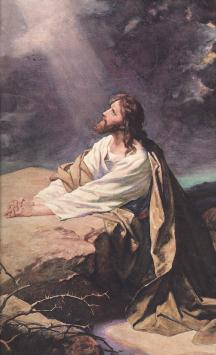
You’ve all probably seen the picture of Jesus praying with his hands folded on top of the rock, with a ray of light shining upon his face. It is a picture of the divine Jesus in deep contact with the Father; worried but confidently in control of circumstances.

Mark paints a dramatically different picture in this gospel passage!

- Jesus is “troubled and distressed” (Mark 14:33). Some scholars say that a more accurate translation should be “horrified and shocked.”

- He begs the Father to exempt him from what is about to happen, and he prays this not once, but thrice.

- He is frustrated with Peter, James and John (his core leaders) who probably drank too much wine.

But this is also the passage where:

- Jesus addresses God as “abba, father” for the first time.

- the proverbial “not what I will but what you will” is uttered

Abba is an endearing name of “father” usually uttered by a baby, and is similar to what we call our fathers, e.g. “daddy,” “papa” and so on. This shows the intimate relationship that Jesus had with God, connoting unquestionable trust. “Father,” on the other hand, expresses an intelligent appreciation of the relationship. The two together express the love and intelligent confidence of the child.

Note that by saying Abba, Jesus is also already saying “not what I will but what you will” in the beginning of His prayer.

Yet, Jesus was not confident at this stage. He asked that the “cup” be taken away from him. (“Cup” is an Old Testament metaphor for punishment and divine retribution.) Jesus was filled with doubt, fear, and second thoughts.

This is not the divine Jesus in control; this is Jesus in his most human condition. This is not Jesus the Master, but the disciple to the Father, struggling with having to suffer. At agony in the garden, Jesus and we are MOST ALIKE.

Interpretation:

A major theme of the gospel of Mark is that DISCIPLESHIP ENTAILS SUFFERING. This is why Mark was not hesitant to present Jesus in his weakest circumstance. He knew that there were many Christians at that time who were either suffering OR were afraid of suffering.

Mark presents him as like a lamb being led to the slaughter. Jesus was tempted to walk away. He prays that he be allowed to do so. He does these three times, but always ending with “not what I will but what you will.”

Generalization:

We often pray “not what I will but what you will”. When we pray this, let’s admit that in the back of our mind, we hope that what we will is ALSO God will.

The gospel’s message is that God understands our struggle; he felt it too in the garden. But just like Jesus, we accept, and desire, God’s will together with every difficulty, heartache, and joy that comes with it.

Mark’s message is still true: to be a disciple is difficult, it entails sacrifices. Jesus’ “your will be done” does not mean a passive acceptance of whatever circumstances befall us. It means a “YES” to sacrifice as part of discipleship.

It is difficult to:

- attend to a difficult lamb

- forgive a person who hurt you for the second time

- keep on serving when your efforts are not recognized

- be kind and generous on a bad day

- let go of someone you love and move on

- break off from a “bad” but comfortable relationship

- wait than to settle for the next best thing (person)

- avoid bad company when asked to have a good time

- break industry practice which is wrong, but everyone is doing it

- correct a friend

- take the initiative in reconciling a friendship knowing that that the other person is wrong

- take an insult and silently understand

- and so on.

You’ve heard it said in corporate parlance that “the road to excellence is not easy.” Did you ever think that the road to discipleship would be any less easy?

Application:

You are most likely doing a lot of sacrifices right now as you travel the road of discipleship. What is the most difficult of these sacrifices? What do you consider to be the “next level” that is being asked of you?